I Ship App Features From My Phone Now
Every coding agent I’ve used makes the same assumption about me: that I’m sitting at a desk, watching it work, ready to answer the moment it has a question.
I’m almost never that person. I help several founders build their products, my partner and I have just started an event planning business, and whatever time is left for my own ideas comes in seams: twenty minutes before a check-in, a queue at a government office, the last hour of the night with my phone still in my hand.
So my agents spent most of their time waiting. They weren’t waiting on compute or on code. They were waiting on me, for a thirty-second decision I wasn’t around to make.
Findly, a social app I’ve been building for interior designers, got built anyway, almost entirely inside those seams. That happened because of a harness I designed around one idea: the agent should do the long work on its own and hand me only the decisions, cut small enough to make from my phone.
What made that possible was a custom-built agent harness and workflow built specifically for my hectic schedule.
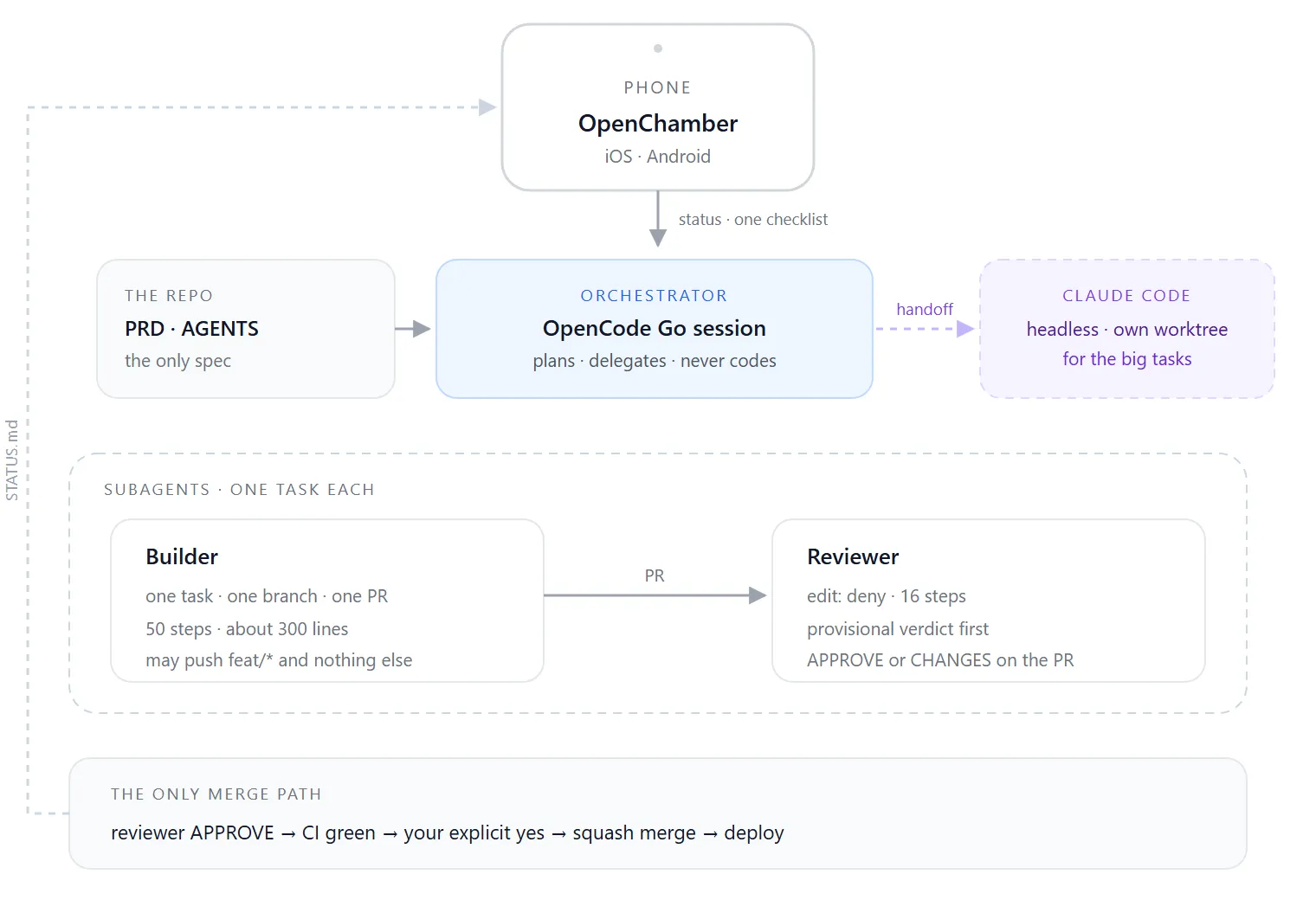
Figure 1 — The loop. A phone session reads a five-line status, answers one checklist, and a PR comes back through a gate I control.
I found a useful framework for talking about this in Birgitta Böckeler’s harness engineering article on martinfowler.com. The split that stuck with me is between guides, which steer the agent before it acts, and sensors, which check the result afterwards and feed corrections back. My harness was heavy on guides and light on sensors. Most of the work was closing that gap.
The pieces, and the contract between them
Out of all the plans available out there, I needed to find one that was both efficient and flexible.
OpenCode Go ticked all the boxes for me. Not only does the monthly Go plan give you a generous amount of access to lower-cost models such as DeepSeek V4.1 Flash and GLM-5.3-Flash for only $10 a month, it works seamlessly with other coding agents such as Hermes, Codex, and Pi.
Out of the current lineup of available harnesses, I specifically wanted an open-source tool that excels at cross-device continuity (I run a Windows PC, CachyOS on my laptop, and have both an iPhone and Google Pixel). I also needed a workspace GUI that makes it incredibly easy to view multiple projects at a glance. Given that, I chose OpenChamber, which has an excellent Android application and offers a quick QR code setup for private remote access.
The contract is simply made of two files. agent/PRD.md is the product scope: numbered features, each with the behaviour it must have. AGENTS.md has the rules — stack, commands, conventions, and the list of specifications nobody may touch. Every queued task cites a PRD section, so “build me X” becomes a specific piece of the product. If I ask for something the PRD does not cover, the orchestrator says so and marks the task blocked rather than inventing scope. That one rule is worth more than any prompt I have written: it is what stops an agent from confidently building the wrong app.
In the framework’s terms, those two files are feedforward guides. AGENTS.md carries the conventions the agent can’t infer from the code: stack, commands, and what nobody may touch. The PRD carries behaviour: numbered features, each with something a reviewer can check. Requiring every task to cite a PRD section is what keeps the guide specific. A spec that can’t be traced to an acceptance criterion is just background reading.
The org chart
All three agents run the same model. What separates them is permission.
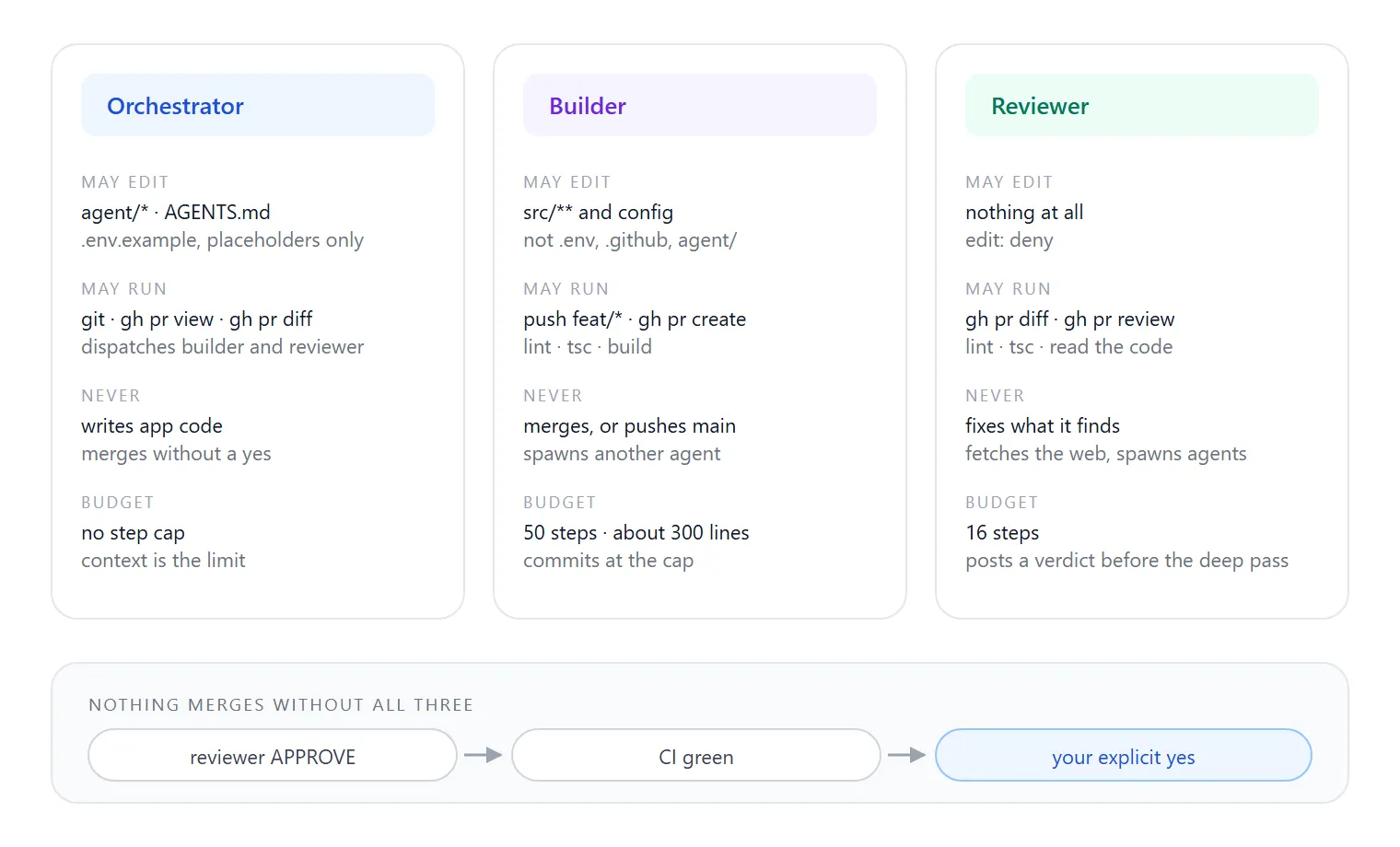
Figure 2 — Three roles, three permission sets, one gate. The reviewer’s power is that it cannot fix anything.
The orchestrator is the only agent I talk to, and it never writes app code. Its edit permission is a deny-all with three exceptions: agent/, AGENTS.md, and .env.example for placeholders. It turns a paragraph into queued tasks with acceptance criteria, dispatches them, reads CI, and asks before merging. Its instructions tell it to delegate if it catches itself reaching for a source file.
The builder gets one task, one branch, one pull request, fifty steps and a soft ceiling of about three hundred changed lines. It may push feat/* and nothing else. No main, no .env, no migration without an explicit ask. Every run ends with a Needs handoff: line, even “none”, because the real failure is a terse run that omits the field and lets unfinished work pass as done.
The reviewer has edit: deny. Sixteen steps, no web access, no ability to spawn agents. It posts a provisional verdict on the PR before it reads deeply, then an amendment if the deep read changes its mind. That ordering is deliberate: runs do get cut off, and a verdict that exists only in a chat message that never came back is worth nothing. Its whole job is literal — each acceptance criterion against the diff, pass or fail.
And in this set up, nothing merges to production unless I explicitly say so. gh pr merge is an ask, granted to exactly one agent, and honoured only after I say yes in that session. Once the reviewer subagent approves, and the CI is all green, the orchestrator pings me back with a checklist item for “Merge #154.”
Ask me with buttons
I read on a phone. So every check-in has a fixed shape: status in five lines or fewer, then exactly one multiple-choice question with two to five options, multiple answers allowed, the recommended one first and marked. I tick “Merge #153” and “Rotate the token” and submit in one tap.
Prose questions are effectively banned, because a paragraph on a phone becomes homework. The side effect is a decision log. Last week’s status entry reads: “he ticked Dispatch T-087; his other four options went unticked.” That is the entire record of a session, and it is more honest than a summary anyone would have written afterwards.
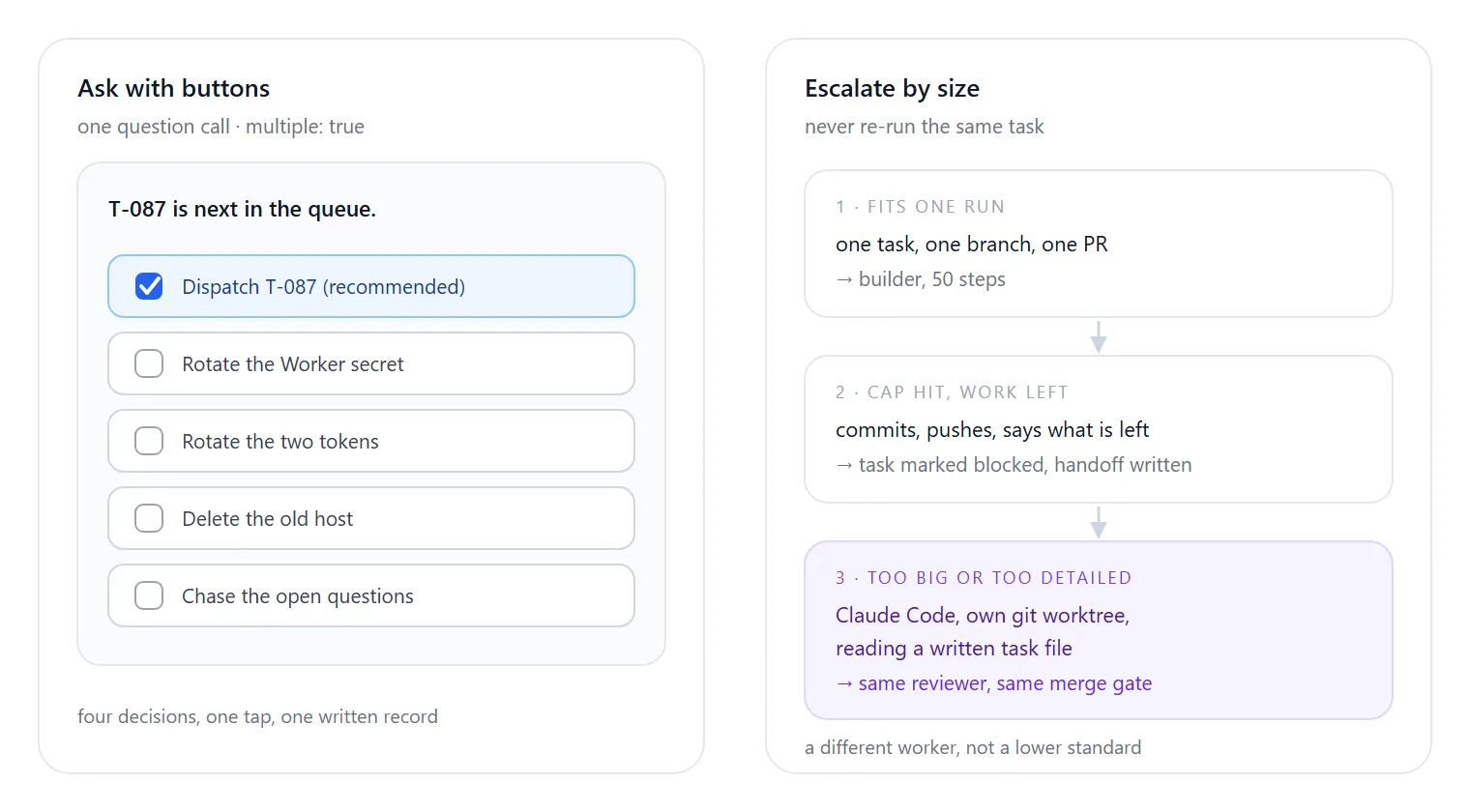
Figure 3 — Left: the only shape a check-in takes. Right: what happens when a task does not fit one run.
Escalate by size, do not retry
Small agent runs fail predictably: they exhaust their steps mid-feature with the work uncommitted. The obvious fix — more steps — was wrong, and the usage data said so. Nine of fifty-eight builder runs had stopped at exactly the old ceiling of sixty; nineteen of forty-nine reviews at exactly twenty. The cap had quietly become the budget.
So the caps came down and the rule changed. At the cap, an agent commits, pushes, opens a draft PR if there is not one already, and reports. If real work remains, the task is not re-dispatched. It is marked blocked with a written handoff: branch, what is done, what is left, the next command to run. Then Claude Code picks it up headless in a fresh worktree, reading that file. It inherits the same reviewer and the same no-merge rule.
What this phone experiment actually changed
I still don’t prefer working from a phone. I’m too fond of my multi-screen setup. But the harness taught me something: work flows more smoothly once the unit of my attention is a decision instead of a task.
What I want is the arrangement a real organization already has with a junior developer. I spend less time guiding an agent through back and forth, and I trust them to communicate clearly and briefly, so the only thing left for me is the decision.
They do the hard work: summarizing the paths that could succeed, naming the tradeoffs, and surfacing a few options, as infrequently as possible. That leaves me free for the dozens of other things going on in my life.
The harness is open source: github.com/deionmenor/agent-harness.